

CASE STUDY:
GREENHOUSE GAS MONITORING
GHGSat
SFL’s Pioneering Small Satellite Attitude Control Technology Enabled GHGSat’s Commercial Greenhouse Gas Monitoring Constellation Mission
OVERVIEW

A NewSpace startup in Montreal called GHGSat had a vision for a commercial business – Using satellites to detect and measure greenhouse gas emissions from industrial and other sources anywhere on Earth. The challenge, however, was significant. Satellites small enough to satisfy commercial budget constraints over 10 years ago (circa 2014) typically lacked the on-orbit stability and sensor pointing capability to precisely measure such emissions.
Advanced attitude control of the satellite would be key to the pointing and stability challenge, which was complicated by the fact the onboard sensor would have to point accurately at a known location on the ground long enough to capture a useful reading. GHGSat calculated the pointing accuracy had to be within 2.6 kilometers of the emissions source’s center point and not only remain on target for 20 seconds but sweep slowly over it, which meant the satellite would have to precisely pan, or slew, in orbit as it passed over the area of interest.
CHALLENGE

Advanced Satellite Attitude Control Enables Precise Ground Target Tracking
The Montreal firm ultimately didn’t have to look far to find the performance capabilities it sought. SFL in Toronto had been focused on developing technologies to address attitude control issues for smaller satellites since its inception in 1998 and had already completed multiple successful missions requiring accurate pointing.
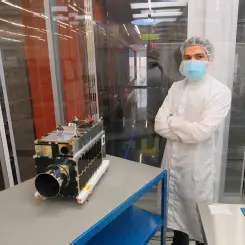
SFL submitted a proposal based on specifications outlined by GHGSat and won the contract to develop the GHGSat-D demonstration microsatellite, also known as “Claire.” SFL built the microsatellite on its Next-generation Earth Monitoring and Observation (NEMO) platform. Development was completed in just two years, and GHGSat launched Claire in June 2016 to prove that greenhouse gas emissions from point sources on the ground could be monitored from space.
At first glance, accurate satellite pointing may not seem like a major accomplishment until the size of the GHGSat platform is considered: The Claire bus measures 20x30x40 centimeters and weighs only 15 kilograms, putting it at the lower end of the microsatellite class. During the planning of the proof-of-concept mission, very few satellites in the small, micro and nano classes at the time had demonstrated the level of attitude control required for this type of application.
Claire was a resounding success, and the Canadian company announced plans less than a year later to build two commercial microsatellites based on the same design as the demonstration mission.
The ability to point accurately and implement advanced control modes is essential in a satellite built for applications that involve looking at or measuring something on the ground or out in space, explained SFL’s director, Dr. Robert E. Zee. When his organization opened its doors in 1998, there had been virtually no attitude control technology developed for smaller satellites.
RESULT
Small Satellite Innovation Delivers Big Performance
Based on the success of AISSat-1 and -2, NSC opted to expand Norway’s satellite activities and created the NorSat program. While the primary application remained ship tracking, the satellites would also carry scientific instruments and/or technology demonstrations for a variety of projects. Following an international open bid process, NSC awarded the contract for the NorSat satellites to SFL.
“SFL beat out other suppliers based on technical merit, price, and schedule,” said NOSA’s Jones. “[SFL agreed to] a contract for NorSat-1 with options for extra satellites…and that made the acquisition process for the other satellites a breeze.”
“At that time, micro- and nano-satellites were thought of as toys tumbling in space, and you couldn’t do anything serious with them,” said Zee. “Advanced attitude control opens the door for smaller satellites to perform complex missions that are also extremely cost effective.”
Zee and his Toronto team had set their sights on developing or modifying technologies that would enable smaller satellites to do everything the bigger, more expensive ones could (within the constraints of instrument physics of course). SFL proceeded to bid on and win contracts for nearly every type of application traditional-size satellites are used – Earth observation, space astronomy, and scientific research – many of which require advanced attitude control for pointing.
Earth observation is one of the most common application areas where stable satellite pointing is so important. Satellites must keep their sensors pointed directly down at the Earth to capture nadir imagery of ground features as the satellites pass overhead. A more complex variation of this has the satellite slewing, or panning, from side to side to collect off-nadir imagery of the surface at an oblique angle.
“Among the most complicated of these missions is ground target tracking, which is the technique required by GHGSat,” said Zee. “The satellite points its sensor at a specific feature or spot on the ground, and the satellite slews to stay pointed at the object for a period of time as it passes overhead.”
SOLUTION

Solving the Attitude Control and Sensor Pointing Problem
Attitude control and pointing stability are more challenging with smaller satellites than larger ones due to the difference in masses (inertia) of the platforms. In the same way a large airliner is more stable than a small airplane in high winds, the greater mass of a traditional-size satellite enables it to better withstand the forces acting upon it in orbit.
“Smaller boxes tend to be more easily rotated in orbit and are more difficult to stabilize because they don’t have as much inertia,” said Zee. “Rotational disturbances or torques caused by the Earth’s atmosphere, its magnetic field and solar radiation impact the attitude of a spacecraft in orbit.”
Large satellites utilize a combination of sensors and actuators controlled by onboard algorithms to stabilize the platform and achieve the desired pointing accuracy. With the goal of attaining the same performance in smaller satellites, SFL began developing miniaturized and more precise sensor and actuator hardware and writing its own advanced algorithms to meet the exacting control requirements of the less massive nano-, micro- and small-satellite buses.
In many missions, SFL uses two types of small actuator to change the attitude of the spacecraft in orbit. The first was co-developed by SFL, and these are small reaction wheels. Ranging in mass and varying from a few to tens of centimeters in diameter depending on the size of the satellite in which they are used, the reaction wheels used by SFL are sold commercially and widely used in the microspace community.
The second type of actuator is a custom, scalable magnetorquer that works against the Earth’s magnetic field. Magnetorquers are often also used to dump, or remove, the momentum stored in reaction wheels to avoid the saturation.
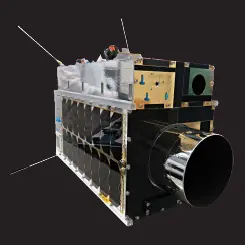
While these actuators rotate and slew the spacecraft, miniaturized onboard sensors constantly measure the spacecraft’s orientation. SFL uses precise sensors to determine the attitude of its platforms relative to star maps, the sun or the Earth’s magnetic field. A miniature star tracker, for example, helps the satellite find its proper orientation by comparing its view of stars in space against a star map stored in onboard computer memory.
“There is no one-size-fits-all solution for hardware in attitude control. We devise a combination of actuators and sensors that meet the particular pointing and stability requirements of a given mission,” said Zee.
The most critical component of attitude control, however, is the software that finely coordinates the movements of the actuators and responses of the sensors to point the satellite in the right direction. SFL developed its control algorithms from scratch and has continued to fine tune them over two decades. Each new mission has unique challenges and requires customization of the software.
One of the keys to SFL’s success, according to Zee, is a proprietary high-fidelity simulation software his team wrote to custom design each mission. By simulating how a proposed platform must perform in space to meet the needs of a given application, SFL selects the right combination of actuators and sensors and software modifications to achieve the desired pointing and stability results.
Author’s Note: A longer version of this article appeared in a 2024 issue of Satellite Magazine.