

CASE STUDY:
ARCTIC SITUATIONAL AWARENESS
Gray Jay
Canada Enhances Arctic Situational Awareness with ‘Gray Jay’ Microsatellite Cluster Developed by SFL
OVERVIEW
Canada has strengthened its sovereignty and enhanced situational awareness in the Arctic with a microsatellite demonstration mission developed by SFL under tight budget constraints. The Gray Jay constellation of three 30-kg formation-flying satellites launched on January 14, 2025.
CHALLENGE
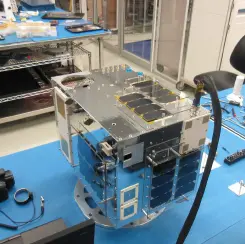
SFL developed the Gray Jay mission for Defence Research and Development Canada (DRDC) to demonstrate that surveillance in Canada’s vast Arctic region could be supported with small satellites. The microsatellite cluster flies in close formation and carries multiple sensors to enable independent methods of detecting surface and airborne objects, including radio frequency (RF) geolocation.
“Monitoring activities in the harsh high-latitude environment of the Arctic with space-borne assets is crucial to safeguarding national resources and interests,” said SFL Director Dr. Robert E. Zee. “SFL is proud that our affordable microspace technology has made this ambitious demonstration mission a reality on a small budget.”
RESULT

Following a competitive process, DRDC selected SFL for the Gray Jay mission due to SFL’s highly successful track record in precise attitude control and formation flying. SFL was among the first microspace developers to affordably accomplish this feat at low cost.
For Gray Jay, precise and accurate attitude and formation control are critical to enabling the mission.
Due to the sensitive nature of the mission, DRDC has not released detailed results other than confirming the satellites are performing successfully and collecting data as anticipated for Arctic situational awareness applications.