

CASE STUDY:
RF GEOLOCATION & FLEX PRODUCTION
HawkEye 360
Flex Production Enables NewSpace Companies to Reduce Satellite Manufacturing Costs While Leveraging SFL Quality and Technological Edge
OVERVIEW

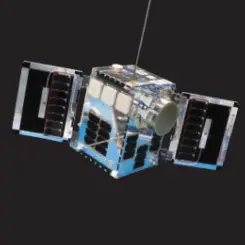
The April 2023 launch of three HawkEye 360 radio frequency (RF) geolocation microsatellites was the seventh spacecraft cluster launched by the commercial U.S. company and the first developed under the SFL Flex Production Program. This flexible satellite development plan was created by SFL to accommodate the budget-aggressive business models in NewSpace ventures.
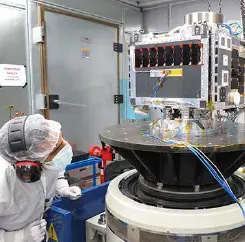
While SFL handled the entire development process for the first six HawkEye 360 clusters in Toronto, SFL delivered satellite units for Cluster 7 to HawkEye 360’s new manufacturing facility in Virginia where the U.S. company performed the spacecraft integration and testing with technical guidance by SFL.
Based on its success with Cluster 7, HawkEye 360 integrated Clusters 8, 10, 11, 13, and 14 at its facility under Flex Production. SFL has developed, integrated, and tested Clusters 9 and 12 in Toronto with design upgrades for enhanced operational capabilities. All clusters through Cluster 14 have been launched. HawkEye 360 Clusters 15 and 16 are now under development in Virginia.
“The hybrid manufacturing approach is a winning combination,” said SFL Missions Director Dr. Robert E. Zee. “Flex Production gives our NewSpace clients the best of both worlds by leveraging our Microspace expertise while meeting the competitive financial requirements of their commercial business models.”
HawkEye 360 has established itself as the leading global provider of space based RF signals intelligence, leveraging its expanding constellation to collect, characterize, and geolocate RF emitters worldwide. Building on a long standing partnership with SFL’s Flex Production Program, HawkEye 360 delivers advanced unclassified signals intelligence that supports maritime intelligence, air defense radar monitoring, GNSS interference monitoring, communications mapping, and spectrum awareness. The company’s proven capabilities enable governments and allied nations to understand and navigate complex RF environments with exceptional precision and reliability.
“We were early adopters of SFL’s Flex Production Program, and that foundation has been central to our success,” said Christopher Habib, Principal Director, Space at HawkEye 360. “Three years on, SFL continues to be a trusted technology partner, providing reliable, heritage driven satellite buses that have enabled us to scale our constellation and advance our mission with confidence.”
HawkEye 360 originally selected SFL to build the first Pathfinder Cluster in 2018 due to SFL’s space-proven formation flying technology for multiple satellites in orbit – a crucial capability for terrestrial RF signal geolocation from space. Based on Pathfinder’s success, SFL continued to develop microsatellites for HawkEye 360.
CHALLENGE
NewSpace Competition Demands Technology Enhancements
SFL built its business on comprehensive mission development, delivering services from design conceptualization through spacecraft manufacture. If requested, the SFL team also assists clients in arranging launch services and setting up ground stations and/or mission control facilities. As the NewSpace era matured, however, SFL saw an opportunity to modify its end-to-end service offerings with production options to support that sector’s increasingly competitive economics.
NewSpace companies are vertically integrated from top to bottom, explained Zee. Their primary business objective is typically to collect data, analyze the data, or extract information from the data and sell data products. Satellites are merely the tools they use to create these products and services. To control costs, they usually maintain every aspect of their business in-house – from building and operating their satellites to analyzing the data and selling to customers.
“Like any commercial organization, a NewSpace company seeks to maximize the efficiency of the value chain to reduce costs – and for many that means building their own satellites, especially where mass production fosters economies of scale,” said Zee. “But what if there was a way to satisfy NewSpace economics while also benefiting from SFL expertise in spacecraft development?”
RESULT
Satellite Attitude Control is Crucial to Agility
Always looking for a better way to serve potential customers, SFL decided to offer customized production options to help minimize the NewSpace cost base and make their business models more viable while leveraging SFL’s strengths in design, innovation and heritage.
Improving the NewSpace client’s finances, however, is just one benefit of the SFL offering.
“The challenge for commercial NewSpace companies is keeping up with their competition by constantly upgrading their products and services,” said Zee. “More often than not, this means continually enhancing their satellites. But that requires maintaining intense and continuing expertise in spacecraft development which is a separate business model entirely. That’s where SFL comes in.”
Zee elaborated: NewSpace companies can affordably hire a staff of technicians to assemble, integrate, and test satellites in an integrated workflow, but the need to change the spacecraft design quickly and effectively and implement newer technologies is a different challenge and area of specialty. If the latter is to succeed, it requires a dedicated team of engineers that does nothing but spacecraft development to remain competitive.
“For most NewSpace companies, it’s simply not cost effective to maintain a ‘company within a company.’ Either you are good at selling data, or you are good at designing reliable spacecraft – it’s not easy to do both well,” said Zee. “Developing new cost-effective satellites that work the first time is our specialty at SFL – it’s all that we do, and we do it for many different applications, missions, and customers year after year.”
Zee concluded: “Flex Production enables clients to tap into our powerhouse expertise and legacy of success while still benefiting from NewSpace economics. The best of both worlds.”
At the end of the day, he concluded, this enables the NewSpace company to focus on their primary business objective, which is selling products and services, while SFL focuses on its business goal, which is developing high-performance, low-cost satellites. The overall result is the NewSpace client can remain confident that its assets in space are of the highest quality and reliability while maximizing returns from NewSpace economics.
Author’s Note: This case study is an updated version of a feature article that appeared in a 2023 issue of Satellite Magazine.