

CASE STUDY:
DRAG SAIL DEORBITING
CanX-7
SFL Demonstrates Cost-Effective Deorbiting of Retired Satellite with CanX-7 Drag Sail Technology
OVERVIEW
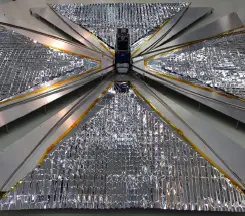
A drag sail designed by SFL safely deorbited a demonstration nanosatellite in 2022 – less than five years after completion of the spacecraft’s primary mission. That’s roughly 178 years before the satellite would have deorbited without the drag sail and well within the 25-year deorbiting target recommended for retired satellites by the Inter-Agency Space Debris Coordination Committee (IADC).
“Orbital debris is a big concern for the space industry, and the passive de-orbit technology demonstrated on CanX-7 is an advantageous solution for nano- and microsatellites,” said SFL’s CanX-7 Mission Manager, Brad Cotten. “The mission verified that SFL’s lightweight drag sail technology is a more cost-effective and less complex method for deorbiting smaller satellites than traditional propulsion techniques.”
Additionally, the deorbiting technology allows nano- and microsatellites to be launched into a wider range of orbits than would be possible if natural orbital decay were to be relied upon.
CHALLENGE
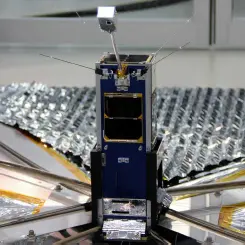
SFL developed the 3.5 kg CanX-7 as a two-fold mission with a primary objective of demonstrating Automatic Dependent Surveillance – Broadcast (ADS-B) message collection from space for global aircraft situational awareness. Its secondary mission was to test the effectiveness of the drag sail technology devised by SFL.
“The SFL drag sail technology developed for nano- and microsatellites is among the only commercially viable deorbiting devices available today, aside from propulsion, that reduces the time retired small satellites spend in orbit as space debris.” said SFL Missions Director Dr. Robert E. Zee. “The drag sails performed better than designed, deorbiting CanX-7 in far less time than the maximum 25-year IADC target.”
RESULT
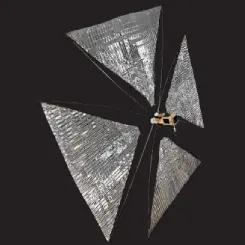
The 10x10x34cm nanosatellite launched in 2016 and completed its primary mission in a year. SFL deployed the four drag sails – each about one square meter in area – on May 4, 2017, with the intent of decreasing the ballistic coefficient of the spacecraft and using atmospheric drag to accelerate orbital decay. Mission participants observed an almost immediate change in altitude decay rate and continued tracking the orbital decay rate until CanX-7 re-entered the atmosphere on April 21, 2022.
CanX-7 was funded by Defence Research and Development Canada, and the Natural Sciences and Engineering Research Council. COM DEV Ltd., and the Canadian Space Agency provided the ADS-B payload. Project participants lauded the successful end to the mission, which is the first Canadian satellite to be independently deorbited by commanded atmospheric re-entry.
According to Dr. Lauchie Scott, defence scientist with Defence Research and Development Canada (DRDC), the CanX-7 drag sail deployment campaign provided a very rare opportunity to observe a satellite drastically change shape and size while being tracked by ground-based telescopes. This view showed the nanosatellite’s brightness signature during the sail deployment and how its rotational motion evolved while the longer-term space sustainability deorbit experiment continued.
Dr. Scott added that this was an outstanding Canadian collaboration to help mitigate risk from space debris.
According to Dr. Brad Wallace, defense scientist with DRDC, the project successfully proved that SFL’s innovative drag-sail technology can deorbit a spacecraft decades faster than would have happened otherwise and demonstrated Canada’s continued leadership not only in space technology, but also in responsible space stewardship.
He added that the lessons learned from the CanX-7 mission will be used to help minimize the number of inoperable spacecraft orbiting the Earth, ensuring that space continues to be used to benefit Canadians and people around the world.