

CASE STUDY:
MARITIME MONITORING
AISSat-4
SFL Missions Develops Ship Tracking Microsatellite for Norway in Under a Year
CHALLENGE
When Norway requested SFL Missions develop a new maritime ship tracking microsatellite on a tight schedule to expand the country’s maritime situational awareness network and prevent a potential capability gap, SFL delivered. AISSat-4 is a customized CubeSat solution developed and shipped to the client in less than a year. It was launched by the Norwegian Space Agency (NOSA) in March 2026.
RESULT

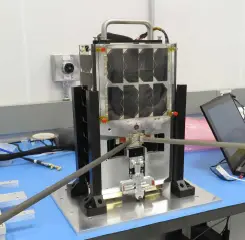
SFL developed AISSat-4 in 11 months on its SPARTAN 6U nanosatellite platform. It carries a single payload – a miniaturized Automatic Identification System (AIS) receiver built by Kongsberg Seatex of Trondheim, Norway. AISSat-4 is the ninth AIS satellite built on an SFL bus for Norway.
SFL Missions was uniquely prepared to develop AISSat-4 on an accelerated schedule due in part to extensive experience designing and implementing AIS missions. Additionally, the SPARTAN platform relies on heritage hardware and software and is easily tailored to accommodate the AIS receiver and antennas.
“Early on, we implemented the Microspace approach to satellite development combined with an emphasis on state-of-the-art design, the right technology for the mission, innovative processes, and thorough testing,” said SFL Missions Director Dr. Robert E. Zee. “The result has been sophisticated microspace missions completed in less time and at a fraction of the cost normally associated with high-quality satellites – satellites that actually deliver what they promise.”
More broadly, he added, SFL Missions Inc. has the capacity to work on many satellite missions concurrently, and since the team is vertically integrated, it maintains full control over the subsystem and spacecraft level assembly, integration, and testing schedules.
Under the leadership of NOSA and the Norwegian Coastal Administration, Norway operates the world’s most extensive and sophisticated space-based marine monitoring system to protect the safety of vessels and sustainability of resources in its vast territorial waters.
Norway launched the first ship-tracking satellite of its operational AISSat series in 2010 and then funded a parallel series of larger NorSat microsatellites. While the smaller AISSat nanosatellites each carry a single payload focused solely on collection of AIS signals, the NorSats each operate a ship-tracking device along with one or more technology demonstration payloads.
Norway’s leadership in space-based maritime monitoring includes nine spacecraft spanning more than 15 years, all of which were developed with SFL.
“AISSat-4 development demonstrates SFL Missions’ unmatched ability to deliver small satellites for diverse applications at price points that are cost effective for commercial and government customers,” said Zee.