

CASE STUDY:
MARITIME MONITORING
NorSat
Multiple Complex Payloads on Small Satellites Developed by SFL Help Norway Achieve Leadership in Maritime Situational Awareness
OVERVIEW

Launches of the NorSat-TD and NorSat-4 microsatellites in 2024 brought to seven the number of maritime situational awareness monitoring spacecraft developed and commissioned by SFL for Norway. Satellites developed by SFL were the first in Norway to receive Automatic Identification System (AIS) signals from ships at sea by a satellite in orbit, thereby dramatically improving ship tracking and vessel safety over a wide area.
Each satellite has presented unique development challenges posed by accommodating one or more payloads on small spacecraft platforms within limited budgets. The satellite-based situational awareness activities have been unquestionable successes for Norway, especially given the budget constraints.
“Norway’s maritime territory is seven times its land area, and we don’t have enough frigates and helicopters to patrol everything,” said Tyler Jones, Norwegian Space Center (NOSA) Senior Advisor and NorSat-TD Project Manager.
CHALLENGE


Pioneering Space-Based AIS Ship Tracking for Marine Safety
Large vessels at sea are mandated to operate AIS transponders that send and receive location identifier signals so ships can avoid collisions. While these line-of-sight signals support safe navigation, the Norwegian Coastal Authority (NCA) saw an opportunity to expand utility of AIS for regional ship tracking, rescue activities, and illegal fishing enforcement by capturing the signals from space.
NCA teamed with the Norwegian Space Centre (NSC, later called the Norwegian Space Agency or NOSA for short) and the Norwegian Defence Research Establishment (FFI) to determine if AIS signals could be captured by satellite.
Under an extremely tight budget, FFI contracted SFL to develop a satellite carrying an AIS receiver/ transmitter designed by Kongsberg Seatex AS of Trondheim, Norway. SFL integrated the device and antenna into its mission-proven 20x20x20 cm Generic Nanosatellite Bus (GNB). Despite its 7-kg mass, the AISSat-1 nanosatellite included an onboard computer and three-axis attitude control. FFI launched AISSat-1 in 2010. Within 24 hours, the space-based AIS reception concept was proven, and the satellite was transferred to operational status. The nanosatellite captured the AIS signals from hundreds of ships in an expansive geographic area and transmitted them to an NCA base station on land. FFI launched AISSat-2, a twin of the first, in 2014 which continued to operate for nine years until October 2023. AISSat-1 remained operational until 2022.
“SFL is proud to have played a key role in expanding the applicability of a crucial maritime safety technology,” said SFL Director, Dr. Robert E. Zee. Microsatellite
RESULT
Microsatellite Development Expertise Enables Multi-Payload Missions
Based on the success of AISSat-1 and -2, NSC opted to expand Norway’s satellite activities and created the NorSat program. While the primary application remained ship tracking, the satellites would also carry scientific instruments and/or technology demonstrations for a variety of projects. Following an international open bid process, NSC awarded the contract for the NorSat satellites to SFL.
“SFL beat out other suppliers based on technical merit, price, and schedule,” said NOSA’s Jones. “[SFL agreed to] a contract for NorSat-1 with options for extra satellites…and that made the acquisition process for the other satellites a breeze.”
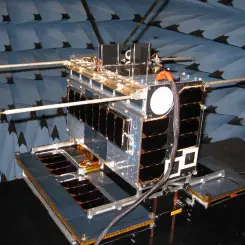
Multiple payloads required a larger platform, and SFL transitioned the program to its Next-generation Earth Monitoring and Observation (NEMO) small microsatellite bus. NEMO gave NorSat-1 the physical size (20x30x40 cm), attitude control, high-speed downlink, and power to carry and operate the three payloads. The total satellite mass at launch in 2017 was 15 kg.
“A major challenge in NorSat-1 development was ensuring electromagnetic compatibility of the upgraded AIS receiver with the satellite systems and payloads,” said Alex Beattie, a senior mission manager at SFL.
The new AIS device was more susceptible to electromagnetic noise than previous receivers, he explained, which meant SFL had to carefully integrate the payloads on the platform and plan their operation in orbit to avoid interference. Another challenge was incorporating the deployable Langmuir probe onto the bus for deployment after launch without damaging the fragile elements.
NorSat-2 posed even bigger challenges with addition of the world’s first VHF Data Exchange System (VDES) payload for high-bandwidth two-way communications.
“VHF data exchange had never been attempted from a satellite,” said SFL’s Zee. “Although NSC provided the VDES device, there was no directional high-gain VHF antenna available for operation from a microsatellite in space.”
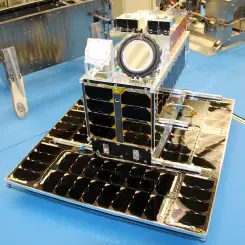
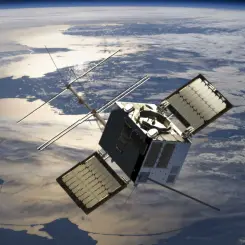
To assist with antenna electromagnetics design, SFL initiated collaboration with the Electrical Engineering Department at the University of Toronto. An electromagnetics professor and his research group engineered the RF aspects of a VHF Yagi antenna based on initial specifications from SFL. To achieve effective performance, the antenna had to extend more than twice the length of the NEMO bus. SFL leveraged its internal mechanical engineering expertise to create a foldable Yagi, compact for launch and then deployable in orbit.
With concerns over ship piracy, sanction breaking, and illegal fishing growing worldwide, NSC (now called the Norwegian Space Agency or NOSA for short) collaborated with NCA to include an FFI-developed experimental Navigation Radar Detector (NRD) on NorSat-3, along with the AIS receiver. Ships operating with nefarious intentions often turn off their AIS transponders or spoof the signal with incorrect location data, making the vessel appear to be somewhere else.
The NRD was added to provide supplemental ship detection and identification for more accurate marine situational awareness desired by NCA, Norwegian Armed Forces, and other maritime authorities.
“The NRD posed two major challenges – development of a first-of-its-kind rigid antenna array and a new attitude control mode,” said SFL Mission Manager, Brad Cotten.
While FFI was responsible for the RF aspects of the NRD antenna, SFL designed the antenna structure with carbon fiber since it was lightweight and unsusceptible to thermal deformation. After manufacture and calibration, the antenna underwent extensive thermal and vibration testing. SFL engineers then had to reconfigure the payload layout on the NEMO bus to accommodate the rigid NRD antenna and avoid radio frequency interference.
SOLUTION
Continuous Innovation to Support Complex Missions
In terms of attitude control, SFL had pioneered the precise pointing of sub-50-kg satellites for Earth observation, atmospheric monitoring, and space astronomy. The NRD, however, required development of innovative attitude control algorithms to maximize scanning of large maritime regions with a very narrow field of view on each orbit. The unique new mode enables the detector to pan across the horizon while maintaining the orientation of the antenna relative to the vertical direction.
Concurrent with NorSat-3, the NorSat-TD (Technology Demonstration) microsatellite was under development at SFL and undergoing an intriguing evolution. The original design called for a duplicate of NorSat-2 carrying an AIS receiver and VDES two-way communication device with Yagi antenna. Both instruments, however, had been upgraded since the earlier mission and would require greater onboard power to operate.
SFL recommended transitioning the mission to its larger microsatellite bus, the 30x30x40 cm DEFIANT platform. This spacecraft offered more power and greater size at 35 kg. NOSA decided to take advantage of the extra capacity and added four experimental instruments from European partners to the manifest. These included satellite-to-ground optical communications, a payload to enhance GPS precision for space situational awareness, a retroreflector to aid in spacecraft tracking by laser, and iodine-fueled propulsion system.
“Volumetrically, the platform was big enough to fit all the payloads but getting them to work together was a challenge,” said Jakob Lifshits, SFL Mission Manager.
He explained that operation of NorSat-TD in orbit required careful planning because all instruments couldn’t function at the same time due to conflicting power demands, thermal thresholds, and frequency interference. In addition, NorSat-TD would have to maneuver in orbit to orient the various instruments in a required direction for optimal performance. The solution involved a combination of strategic device placement on the bus and writing custom software to achieve balanced payload operation.
NorSat-4 presented new development challenges with the addition of a low-light imaging sensor to expand Norway’s ability to detect dark or AIS-spoofing vessels. The imaging system, however, is a demanding payload from a satellite development perspective, explained SFL Mission Manager, Brad Cotten, The imager requires active thermal control to maintain low-light image quality and needs extremely precise attitude control for exact image geolocation.
Another first-of-its-kind development challenge for NorSat-4 has been the design and manufacture of a very compact mechanical iris shutter for the sensor aperture. This SFL-developed shutter opens and closes as needed in orbit to protect the sensor from direct sun exposure. NorSat-4 launched in 2024 and operated as planned.
Author’s Note: A longer version of this case study was published in a 2024 issue of Satellite Evolution magazine.