

Space Flight Laboratory (SFL) Students Place First and Second in Small Satellite Conference Student Competition
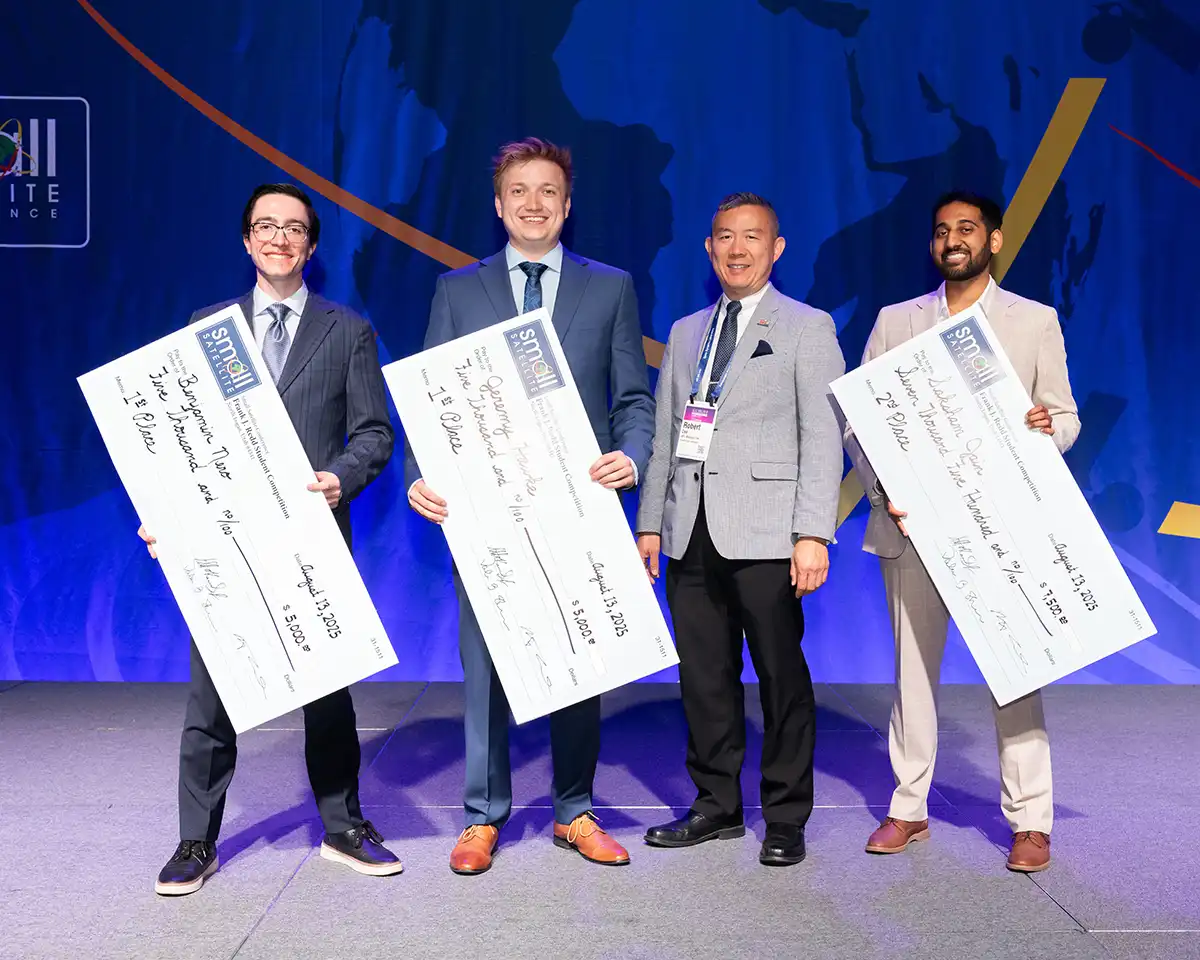
Congratulations to Benjamin Nero and Saksham Jain for placing First and Second respectively in the 2025 Small Satellite Conference Student Competition. Nero and Jain worked on their papers and submitted them to the competition earlier this year while completing their graduate degrees at the Space Flight Laboratory (SFL). Both are now employed at SFL Missions, Nero as a Mechanical Systems Specialist and Jain as a GNC Systems Specialist.
The Small Satellite Conference, held this year in Salt Lake City, hosts a prestigious annual Student Competition in which the entries are judged based on their written technical content as well as the quality of a live presentation in front of an audience at the event.
Ben Nero’s first-place winning paper – co-authored with Jeremy Hawke, a current SFL graduate student – was entitled Compact and Cost-Effective Solar Array Drive Mechanisms to Enable High-Performance Small Satellites. Their research focused on developing an improved system-level design for a mechanism that tracks the sun as a satellite moves in orbit to keep its solar arrays oriented for optimal power generation. Nero and Hawke scaled up an earlier SFL design for a CubeSat mechanism and adapted it for use in micro- and small satellites.
“What makes these mechanisms unique is they are significantly lower cost than commercial alternatives, and they heavily leverage commercial off-the-shelf components,” said Nero. “This significantly reduces the overall development time to produce [compared with] ordering from a traditional manufacturer, which could take more than a year.”
Saksham Jain’s paper, Development of a Tool for Planning Fuel-Optimized Collision Avoidance Maneuvers, takes aim at effectively decreasing the risk of satellite collisions in orbit, a problem that is expected to increase as payload launch traffic into low-Earth orbit grows. Jain’s tool automatically plans avoidance maneuvers for specific satellites in response to potential conflict warnings issued via the U.S. Space Force’s Space Track system, which monitors all objects in the Earth’s orbit.
“This tool takes that message and develops a strategy to maneuver around the other satellite to mitigate any risk of collision,” said Jain. “The new trajectory is uploaded into Space Track, so the operator of the other satellite knows if they need to plan a maneuver as well.”
Commenting on his experience developing the collision avoidance tool, Jain observed that he didn’t know of any other graduate program or internship where students work on such high-level projects: “Just getting the chance to work on this to begin with was a crazy opportunity…I don’t think most [students] get to work on anything involving real satellites with this level of autonomy.”
SFL Missions’ Director and CEO Dr. Robert E. Zee was thesis supervisor to the students and celebrated the two student awards with Benjamin Nero, Jeremy Hawke, and Saksham Jain at the Small Satellite Conference 2025 in Salt Lake City. [See photo.]
Access Ben Nero’s paper here: https://digitalcommons.usu.edu/smallsat/2025/all2025/7/
Access Saksham Jain’s paper here: https://digitalcommons.usu.edu/smallsat/2025/all2025/9/