

GHGSat-C18 and -C19
Global monitoring of greenhouse gases
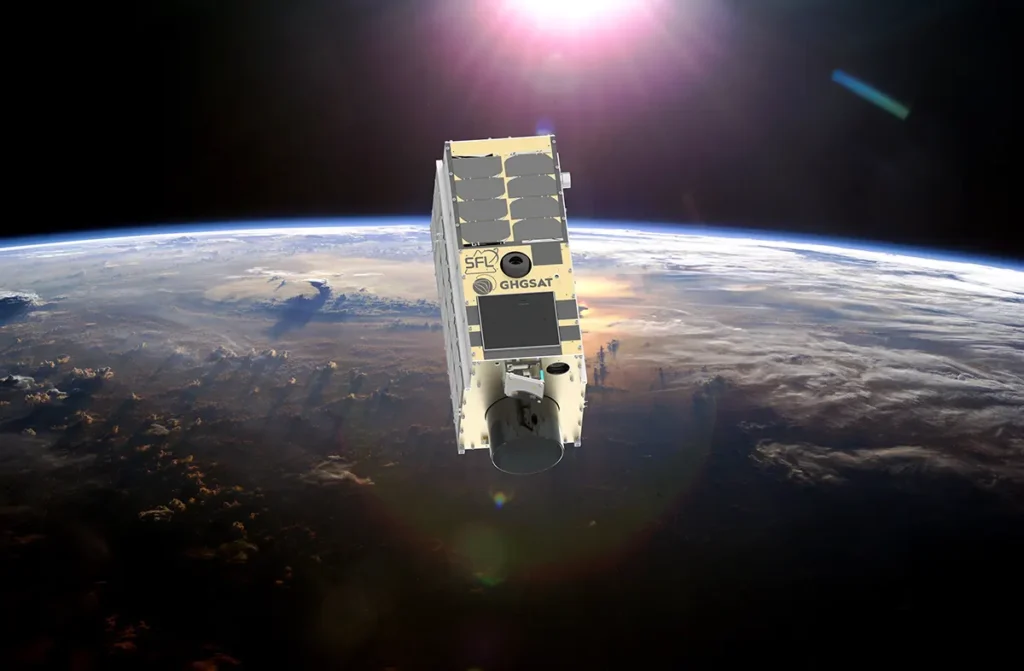
SFL Missions Inc. is developing two additional greenhouse gas monitoring microsatellites – GHGSat-C18 and C19 – for GHGSat of Montreal. The new satellites are being built on the low-cost, high-performance 15-kg NEMO bus, the same used to build 11 GHGSat spacecraft over the past decade.
The precise attitude control and target tracking capability of the NEMO bus play a key role in the performance of the sensors. Using SFL Missions’ trusted attitude control technology for precise pointing of sensors, the GHGSat constellation is able to reliably and accurately detect and measure greenhouse gas emissions from sources on the Earth’s surface.
The GHGSat-D (Claire) demonstration satellite launched in 2016. GHGSat-C1 and C2 launched on 2 September 2020 and 24 January 2021, respectively. On 25 May 2022, GHGSat-C3, C4, and C5 satellites were launched to join the three others already in orbit, and the GHGSat-C6, C7, and C8 satellites successfully launched on 15 April 2023. Most recently launched were GHGSat-C12 and -C13 in mid-2025. All commercial GHGSat spacecraft built on SFL buses remain operational in orbit.
GHGSat is the world leader in detecting and measuring facility-level greenhouse gas emissions from industrial sources on the Earth’s surface from space. Decision-makers across government and industries including oil and gas, power generation, mining, waste management, and agriculture rely on GHGSat emissions data to drive emissions reduction and accelerate the decarbonization of the planet.
In 2023 alone, the satellite constellation made more than three million measurements across 85 countries, enabling the mitigation of more than six million metric tonnes of CO2e of methane emissions, equivalent to removing more than 1.4 million cars from the road for a year.
GHGSat Background
GHGSat’s mission is to become the global reference for remote sensing of greenhouse gas (GHG) and air quality gas (AQG) emissions from industrial sites, using satellite technology.
GHGSat’s novel technology enables GHG and AQG measurement with better accuracy at a fraction of the cost of comparable alternatives.
In each industry, GHGSat measures emissions from target sites, anywhere in the world. Sites can include industrial facilities with fixed, concentrated sources of emissions (e.g., stacks), area sources with emission hotspots (e.g., landfill methane, pipeline leaks), fugitive sources over wide areas (e.g., tailings ponds, mine faces), and mobile emitters (e.g., ships).
Each GHGSat satellite provides periodic, high-precision measurements of emissions from thousands of such sites. Targeting of measured emissions is confirmed with visual imagery from the same satellite. GHGSat instruments are calibrated regularly, and measured data is verified and validated against known sources.
GHGSat provides measurements of emissions at each site without using any on-site equipment. However, GHGSat can augment its measured data with any publicly available data (e.g., local meteorological towers) or private customer data.